

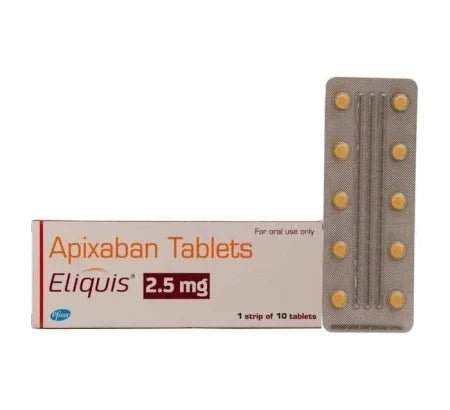
Understanding Eliquis 2.5 mg
Eliquis 2.5 mg is a prescription anticoagulant medication used to reduce the risk of harmful blood clots that can lead to serious cardiovascular complications. The tablet contains Apixaban, an active ingredient that belongs to a class of medicines known as direct oral anticoagulants (DOACs). It is commonly prescribed for patients who require long-term blood clot prevention or management under medical supervision.
Unlike traditional blood-thinning medications that often require frequent monitoring, Apixaban works through a targeted mechanism to help prevent clot formation while offering a predictable therapeutic effect.
Active Ingredient
Apixaban
Apixaban is a selective Factor Xa inhibitor that helps reduce the blood's ability to form clots. By blocking a key protein involved in the clotting process, it helps maintain smoother blood flow through the circulatory system and lowers the likelihood of clot-related complications.
Drug Classification
-
Generic Name: Apixaban
-
Strength: 2.5 mg
-
Drug Class: Direct Factor Xa Inhibitor
-
Dosage Form: Oral Tablet
How Eliquis 2.5 mg Works
Blood clotting is a natural process that helps prevent excessive bleeding after an injury. However, in some individuals, clots can form unnecessarily within blood vessels, potentially causing serious health issues such as stroke, deep vein thrombosis (DVT), or pulmonary embolism (PE).
Eliquis 2.5 mg works by inhibiting Factor Xa, an important enzyme involved in the coagulation cascade. By reducing the activity of this clotting factor, the medication decreases the formation of fibrin, a protein essential for clot development. This action helps lower the risk of dangerous clot formation without completely stopping the body's normal healing mechanisms.
Medical Uses of Eliquis 2.5 mg
Healthcare professionals may prescribe this medication for several clinical purposes, depending on the patient's condition and medical history.
Stroke Risk Reduction
The medication is commonly used in individuals with non-valvular atrial fibrillation to reduce the risk of stroke caused by blood clots.
Prevention of Deep Vein Thrombosis
It may be prescribed to help prevent blood clots in the deep veins, particularly following certain orthopedic surgeries.
Pulmonary Embolism Management
The medication can be part of a treatment plan designed to reduce the risk of recurrent pulmonary embolism in eligible patients.
Long-Term Clot Prevention
Some patients may require extended anticoagulant therapy to help prevent future clot-related complications.
Key Characteristics of Eliquis 2.5 mg
Targeted Anticoagulant Action
Apixaban specifically targets Factor Xa, a critical component of the clotting process.
Oral Administration
The tablet form allows convenient administration without injections.
Predictable Effect
The medication generally produces a consistent anticoagulant response when taken as directed.
Reduced Monitoring Requirements
Compared with some older anticoagulants, routine coagulation monitoring is often less extensive.
Established Clinical Use
Apixaban has become a widely prescribed anticoagulant in modern cardiovascular medicine.
Potential Benefits
When prescribed appropriately, Eliquis 2.5 mg may offer several therapeutic advantages:
-
Helps reduce the risk of blood clot formation
-
Supports stroke prevention in eligible patients
-
Assists in managing thromboembolic disorders
-
Contributes to long-term clot prevention strategies
-
Provides targeted inhibition of Factor Xa
-
Available as a convenient oral tablet
-
Suitable for ongoing anticoagulation management under medical supervision
How to Take Eliquis 2.5 mg
Patients should take the medication exactly as prescribed by their healthcare provider.
General Administration Guidelines
-
Swallow the tablet whole with water.
-
Take the medicine at the same time each day whenever possible.
-
It may be taken with or without food.
-
Do not alter the dosage without medical advice.
-
Continue treatment for the full duration recommended by your physician.
Because anticoagulants affect blood clotting, consistency in dosing is important for maintaining therapeutic effectiveness.
Missed Dose Instructions
If a dose is missed, it should generally be taken as soon as remembered on the same day. Patients should then continue with their regular dosing schedule.
A double dose should not be taken to make up for a missed tablet unless specifically instructed by a healthcare professional.
Possible Side Effects
Like all prescription medications, Eliquis 2.5 mg may cause side effects in some individuals.
Common Side Effects
-
Easy bruising
-
Minor bleeding
-
Nosebleeds
-
Gum bleeding
-
Nausea
-
Mild anemia
-
Fatigue
These effects are not experienced by every patient and may vary in severity.
Serious Side Effects
Immediate medical attention may be required if symptoms such as the following occur:
-
Unusual or prolonged bleeding
-
Blood in urine
-
Black or tarry stools
-
Severe dizziness
-
Coughing up blood
-
Severe allergic reactions
-
Sudden weakness or neurological symptoms
Important Precautions
Before starting treatment, patients should discuss their complete medical history with their healthcare provider.
Special caution may be required for individuals with:
Kidney Disorders
Reduced kidney function can influence how the medication is processed by the body.
Liver Disease
Certain liver conditions may affect blood clotting and medication metabolism.
Bleeding Disorders
Patients with existing bleeding problems may require additional evaluation.
Recent Surgery
Recent surgical procedures can increase bleeding risks during anticoagulant therapy.
Advanced Age
Older adults may require closer monitoring depending on their overall health status.
Drug Interactions
Several medications can influence the effectiveness or safety of Apixaban.
Potential interactions may occur with:
-
Other anticoagulants
-
Antiplatelet medications
-
Certain antifungal medicines
-
HIV treatment medications
-
Some seizure medications
-
Specific antibiotics
-
Nonsteroidal anti-inflammatory drugs (NSAIDs)
Patients should always provide a complete list of prescription drugs, over-the-counter medications, and supplements to their healthcare provider.
Food and Lifestyle Considerations
Unlike some traditional anticoagulants, Apixaban generally has fewer dietary restrictions. However, patients should still maintain healthy habits and follow medical advice regarding alcohol consumption and lifestyle choices.
Activities that carry a high risk of injury should be approached carefully because anticoagulant therapy may increase bleeding risk.
Storage Information
To maintain product quality:
-
Store at room temperature.
-
Protect from excessive heat and moisture.
-
Keep the tablets in their original packaging.
-
Avoid direct sunlight exposure.
-
Keep out of reach of children and pets.
Who May Not Be Suitable for Eliquis 2.5 mg?
This medication may not be appropriate for everyone. Healthcare professionals may advise against its use in patients with:
-
Active major bleeding
-
Severe hypersensitivity to Apixaban
-
Certain serious liver disorders
-
Conditions associated with a high bleeding risk
-
Specific medical situations requiring alternative anticoagulation approaches
Clinical Importance of Eliquis 2.5 mg
Blood clot prevention plays a crucial role in reducing the risk of potentially life-threatening cardiovascular events. Through selective Factor Xa inhibition, Eliquis 2.5 mg provides a modern anticoagulant approach that helps support long-term clot management in appropriate patients. Because anticoagulant therapy requires individualized assessment, treatment decisions should always be made under the guidance of a qualified healthcare professional.
This medication remains an important therapeutic option for patients who require effective and ongoing protection against clot-related complications while maintaining a predictable anticoagulant profile.
What is Lorem Ipsum?
Lorem Ipsum is simply dummy text of the printing and typesetting industry. Lorem Ipsum has been the industry's standard dummy text ever since the 1500s, when an unknown printer took a galley of type and scrambled it to make a type specimen book. It has survived not only five centuries, but also the leap into electronic typesetting, remaining essentially unchanged. It was popularised in the 1960s with the release of Letraset sheets containing Lorem Ipsum passages, and more recently with desktop publishing software like Aldus PageMaker including versions of Lorem Ipsum.
Shipping Details
Estimated ship dimensions: 11.5 inches length x 9.0 inches width x 2.0 inches height
Estimated ship weight: 2.48 pounds
We regret that this item cannot be shipped to PO Boxes.
Lorem ipsum dolor sit amet, consectetur adipisicing elit, sed do eiusmod tempor incididunt ut labore et dolore magna aliqua. Ut enim ad minim veniam, quis nostrud exercitation
Returns
Not happy with a purchase? No problem. We’ve made returning items as easy as possible. And, most purchases can be returned for free. Learn more about our Returns Policy